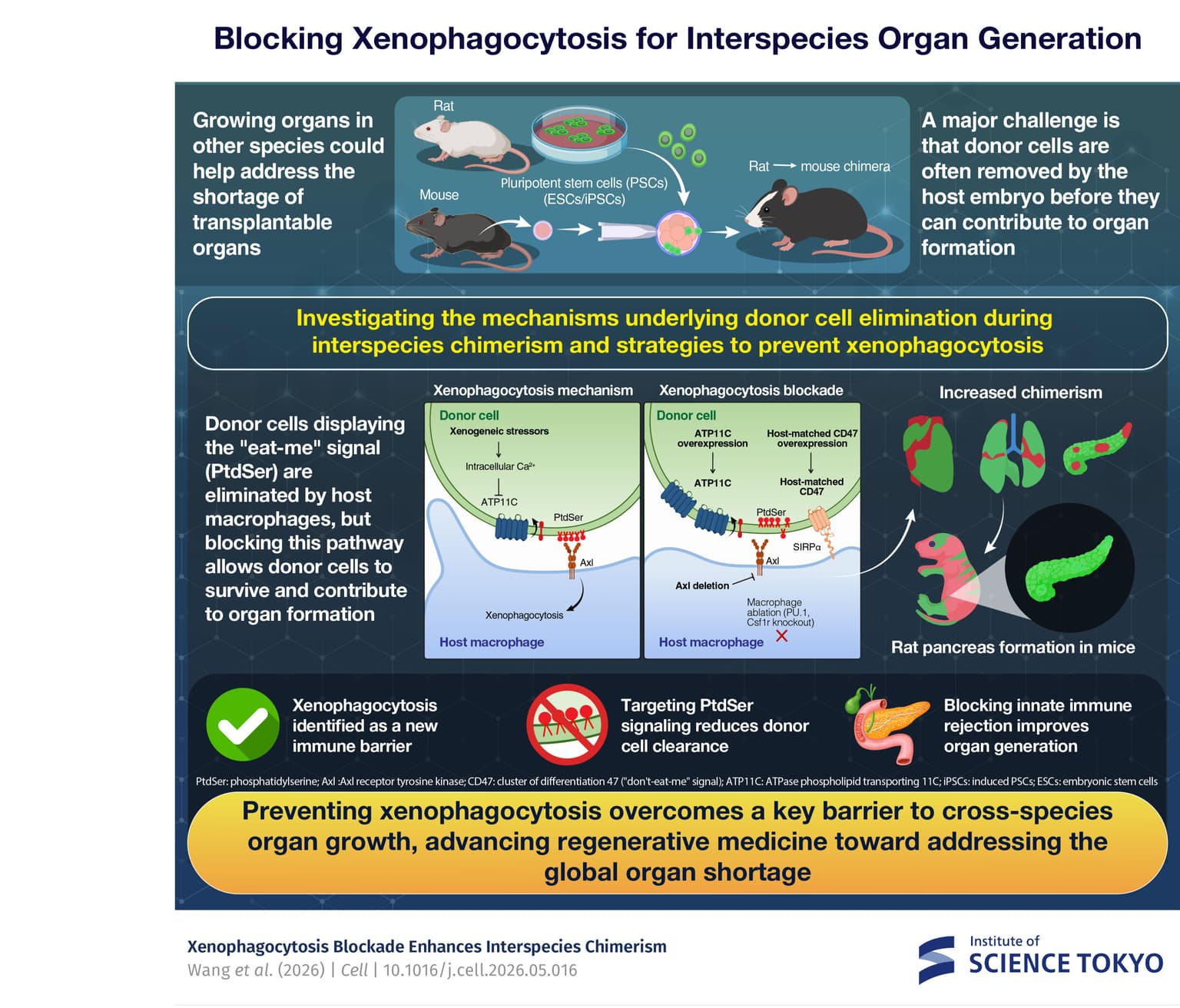
New immune-blocking strategy improves interspecies organ generation
Xenophagocytosis is a natural immune process that limits interspecies organ generation by eliminating living donor cells, researchers at the Institute of Science Tokyo, Japan, report. By uncovering how embryonic macrophages eliminate living donor cells, the researchers developed...
What to take away
Watch whether the progress continues long enough to protect the place or species.
Why it's good
It points to real recovery progress for a vulnerable species or place after sustained conservation work.
Keep reading
More Bright Stories
 Animal Rescue
The Winners of the 2026 International Pet Photography Awards Aren’t Your Average Animal Pics
Anyone who has 5,000 versions of what’s essentially the same photo of their pet on their phone (we get it) will appreciate the artistry apparent in the 2026 International Pet Photography Awards. Now in its eighth year, the competition saw 4,220 entries — from the adorable to the majestic — pour in from amateur and
Nice News - Aug 1
 Animal Rescue
Jimothy the Raccoon Survived Against the Odds, a Testament to Sophisticated Brains and Devoted Mothers
As a neuroscientist who studies raccoon and rats, I see the viral story of Jimothy the raccoon as a compelling tale of an animal overcoming disability and surviving in the wild.
Nice News - Aug 1
 Animal Rescue
First dogs in the UK treated with new bee and wasp venom immunotherapy
The University of Glasgow's Small Animal Hospital is the first in the UK to use a treatment for dogs suffering from serious allergic reactions to bee and wasp stings. The treatment, Hymenoptera Venom Immunotherapy (VIT), has now been successfully used on a number of patients, and while the approach is still relatively new, clinicians believe it offers a way to prevent recurrent anaphylaxis in dogs.
Phys.org Biology - Jul 30
 Animal Rescue
Chicken kidney sponge could be 'outstanding' at cleaning up polluted ports
Ports rank among the most disturbed marine environments. Pollutants like trash, oil and toxins from antifouling paints tend to accumulate in enclosed harbors. Invasive species arriving in ballast water may displace native wildlife, while ship propellers, sonars and dredging cause noise pollution that can interfere with animal communication. There is thus a great need for effective ways to clean up harbors. One promising method is renaturalization, in which hardy species that can survive under these conditions are deliberately introduced to act as pioneers.
Phys.org Biology - Jul 30